SOD Project: Spider Webs Translated into Metal Bowls
The SOD project began as an artistic response to a scientific experiment conducted by NASA in which spiders were exposed to a variety of chemical substances and the webs they produced were closely examined. The experiment documented how different compounds influenced web-building behavior, and the SOD project transforms those recorded trajectories into finished, sculptural objects. Crafted from metal, the bowls capture and preserve the distinct movement patterns each spider traced while under the influence of the various chemicals. The result is a series of striking, tactile pieces that sit at the intersection of art, science, and behavioral observation.
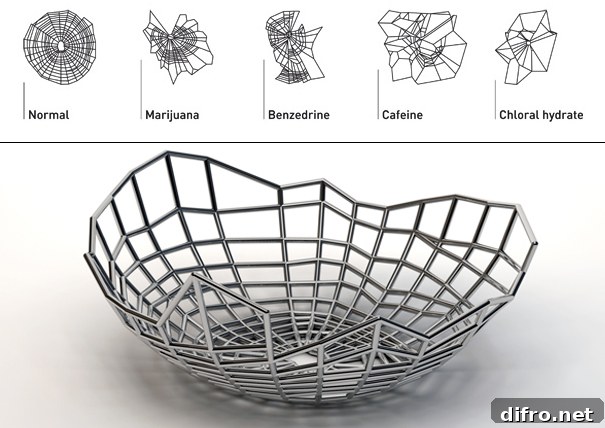
In the original experiment the spiders were given four different substances: marijuana, Benzedrine, caffeine, and chloral hydrate. Each compound produced a characteristic change in the web’s structure, and those differences become readily apparent when translated into three-dimensional form. A typical, undisturbed spider web tends to form relatively regular concentric spirals with an overall dense and symmetrical pattern. By contrast, the webs produced under chemical influence deviate from that norm in ways that reflect altered motor control, arousal levels, and coordination.
Visual Outcomes and Interpretations
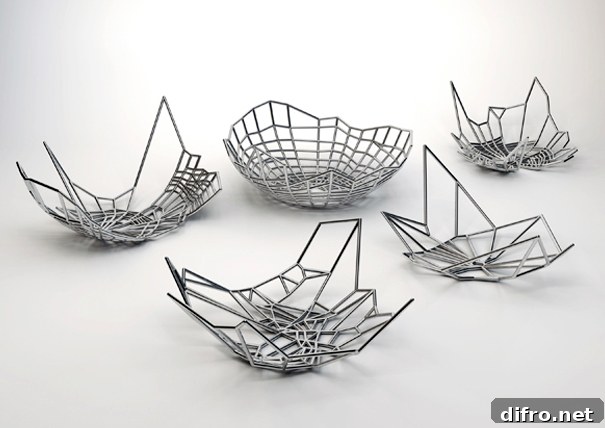
The bowl based on the marijuana-exposed spider captures a web that remains mostly circular but loosens toward the margins. The outer threads show greater spacing and less tension than a standard web, suggesting the spider’s reduced activity or altered precision while working at the rim. The Benzedrine-induced web, produced while the spider was stimulated, appears excited and more frenetic; the pattern is energetic but also contains gaps where expected strands were omitted, pointing to fragmented or hurried behavior. The caffeine-affected web is the most chaotic of the series: the lines are disordered, with a breakdown in the regularity and rhythm typical of normal web construction. Finally, the bowl representing chloral hydrate — a sedative — reveals a pattern that fades and truncates as if the spider slowed and ceased its work before completion, leaving the web incomplete and disconnected.
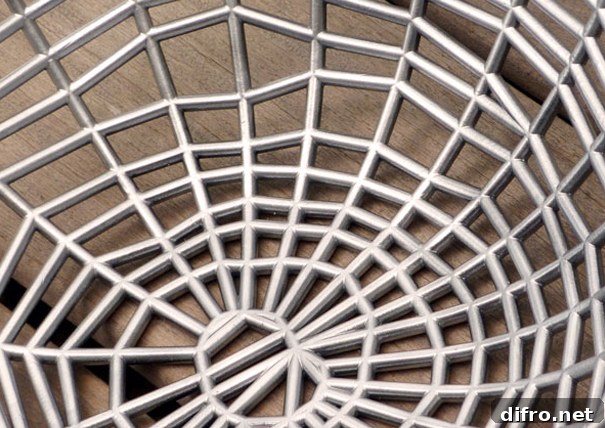
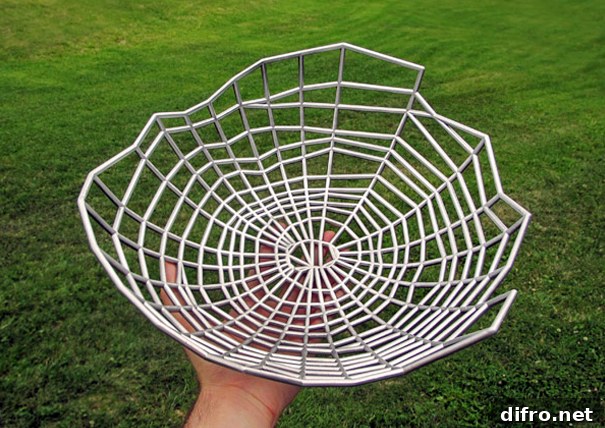
Translating these patterns into metal bowls preserves the motion and rhythm of each web in a durable medium. The bowls act as visual records, turning ephemeral silk structures into permanent objects that speak to both the biological processes behind web building and the aesthetic qualities of the resulting forms. Their metallic sheen emphasizes line, shadow, and negative space, allowing viewers to read the history of movement encoded in each piece.
Art, Science, and Ethical Context
The SOD project occupies a space where scientific observation becomes material art. By using documented behavioral changes as starting points, the work highlights how subtle shifts in physiology and stimulus can dramatically alter a natural behavior. At the same time, these pieces invite reflection on ethical considerations: experiments that alter an animal’s behavior for study prompt questions about consent, welfare, and the balance between scientific curiosity and humane treatment. The bowls, then, serve both as aesthetic objects and as prompts for conversation about the responsibilities inherent in experimental research.
Materials and Presentation
Each bowl is fabricated from metal and shaped to reflect the spider’s tracing. The metal medium accentuates the linear qualities of the webs and allows the interplay of light and shadow to reveal the intricacy of each pattern. Presented on a flat surface or displayed on a wall, the bowls read as diagrams of movement — a record of time, alteration, and behavioral consequence. The collection as a whole demonstrates how material transformation can preserve and reinterpret scientific phenomena for a broader audience.
Legacy and Viewer Response
Viewers commonly respond to the SOD pieces on multiple levels: as curiosities that document altered behavior, as abstract sculptures with strong graphic qualities, and as reminders of how fragile and variable natural processes can be. The project encourages close looking and comparison, allowing observers to visually trace the effects that different compounds had on the spiders’ motor patterns. Ultimately, the SOD project is an example of how scientific data can be reimagined through an artistic lens to create objects that are simultaneously informative, contemplative, and visually compelling.
Source: CultureWaves