Invest in quality design. It’s advice you’ve likely heard before, but it bears repeating: choose craftsmanship, durability and usefulness. A well-made piece—handsome, meticulous and thoughtfully proportioned—settles naturally into any setting. Good design adapts to new homes and refreshed rooms, ages gracefully, and often becomes an heirloom that endures across generations.
Below are examples of credenzas, cabinets and shelving that embody these virtues: investment pieces and statement items that combine form and function with timeless appeal.
CH825 Credenza
To mark the centenary of Hans J. Wegner’s birth in 2014, Carl Hansen & Søn relaunched Wegner’s celebrated 1958 credenza. True to Wegner’s aesthetic, the CH825 is elegant, restrained and impeccably crafted. Its balanced proportions and refined details make it an ideal backdrop for treasured objects and fine tableware, bringing warmth and poise to any interior.
Images © Carl Hansen & Søn.
Tambour Credenza Series
Designed by BassamFellows for their own studio, the Tambour Credenza Series offers a clean, practical storage solution with a refined silhouette. Rounded corners and tambour doors that slide away into the cabinet create a seamless, understated effect. Inside, color-accented shelves add a playful yet elegant contrast, revealing the thoughtful attention to both form and function.
Images © BassamFellows.
Highland Park Drinks Cabinet
The Highland Park drinks cabinet, designed by John Galvin, is a study in classic woodcraft with a contemporary sensibility. Its sculptural, sensuous form and meticulous detailing celebrate natural materials and skilled joinery. The cabinet expresses Galvin’s commitment to sustainable materials, thoughtful design and lasting quality, making it a distinguished addition to any home bar or entertaining area.
Photography © Scott Moore via Alto Magazine.
838 Veliero
Designed in 1939 by Franco Albini for his Milan home and revived by Cassina, the 838 Veliero bookcase combines refined materials with a strong silhouette. The design features ash pillars with brass tips, thin stainless steel tie rods, tempered glass shelves and a steel base. The name Veliero—Italian for sailing ship—hints at the bookcase’s linear, nautically inspired geometry. Bold yet elegant, it functions as both storage and a sculptural focal point.
Images © Cassina.
Mister
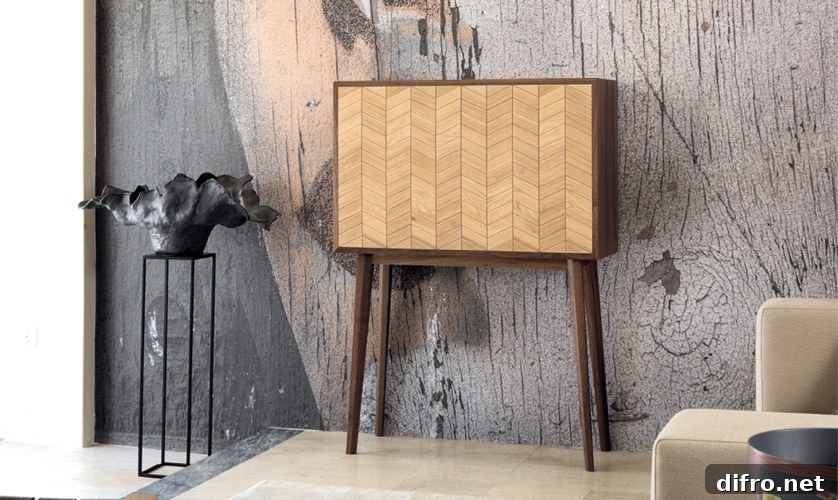
Designed by Daniel Duarte for Portuguese brand WEWOOD, Mister is a versatile sideboard that can double as a desk or bar, depending on the owner’s needs. The piece has a robust, masculine silhouette and is crafted from solid walnut and solid oak. A herringbone pattern on the surface provides a clever, tactile detail that elevates the design without compromising functionality.
Images © WEWOOD.
MK88360
The MK88360 cabinet system was designed in 1928 by Danish architect Mogens Koch. The compact unit measures approximately 76 x 76 x 36 cm and is divided into four sections—two narrow compartments on the left and two wider ones on the right. Its modular nature allows for added shelves and trays, offering flexibility and adaptability that suit changing storage needs.
Images © Carl Hansen & Søn.
Shoji floating cabinet
Nordic and Japanese design share a similar commitment to simplicity, natural materials and quiet beauty. The Shoji floating cabinet, conceived by Toronto’s MJÖLK in collaboration with Studio Junction, draws on midcentury Danish cabinetmaking and the traditional Japanese shoji screen—a delicate lattice covered with translucent paper. The result is a light, almost ethereal wall-mounted cabinet crafted by local artisans in Toronto.
Images © 2015 MJÖLK.
Credenza by Workstead
Brooklyn-based studio Workstead designed a credenza distinguished by its oblique handles, which rhythmically frame the façade and give the piece a distinctive profile. Solid and tactile, the credenza feels substantial without being heavy-handed. Built in either beech or walnut, it offers a refined presence that suits both contemporary and more traditional interiors.
Images © Workstead.